
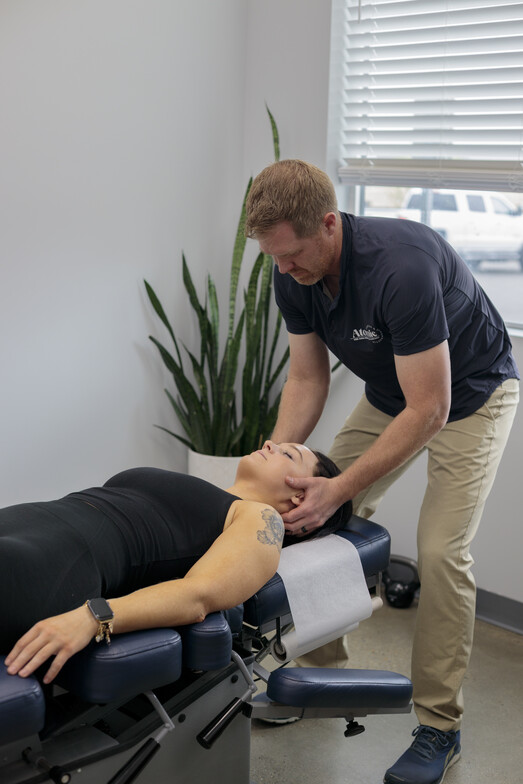
Do you ever catch yourself rubbing the side of your neck after a long day? Maybe you deal with that nagging tension that seems to sit on your shoulders all day long, or those frustrating tension headaches that wrap around your head like a tight band.
If you’ve been hesitant to start an exercise routine or get back into Pilates because you’re afraid of making your neck pain worse, you’re not alone. Many of the women we see in the studio feel the exact same way. They want to be active, but they don’t know where to start safely.
The good news? You don’t have to live with that tension, and relief doesn’t have to be aggressive or scary.
In this week’s video, I’m walking you through a few very gentle, effective ways to release tight neck muscles using Trigger Point Therapy (working on tight “knots” in the muscle) and Myofascial Release (gentle pressure to help tight tissue move better). These are simple techniques you can use right now to help turn down the volume on your pain.
How to Do These Releases Safely
Before we jump in, here’s the golden rule: Be kind to your body.
When we talk about “trigger points,” we aren’t trying to bruise them away. When you find a tender spot, I want you to apply pressure that feels like a 4 or 5 on a pain scale of 1 to 10.
-
Trigger Point Hold: Find the spot and hold for 15–30 seconds until you feel it soften.
-
Myofascial Release: Pin the muscle, then gently move your head to stretch the tissue under your fingers. Repeat 4–6 times.
Here are the four key areas to check.
1. The SCM (The “Head Turner”)
The sternocleidomastoid (SCM) is a thick muscle that runs down the side of your neck. It helps you rotate your head and look down.
Find it: Turn your head to the side and you’ll feel a muscle “pop out” diagonally along the front/side of your neck.
The release: Pinch that muscle gently. You’ll likely find a tender spot. Hold that pressure for 15–30 seconds.
Add movement: Tip your head back and away from your fingers. You’ll feel the muscle slide underneath your touch. Do this slowly 4–5 times to help it let go.
2. The Upper Traps (The “Stress Shoulders”)
If someone has ever told you, “Relax—drop your shoulders away from your ears,” this is the muscle they’re talking about. When we’re stressed, we tend to hike our shoulders up, creating knots right at the base of the neck.
Find it: Reach your hand across to the opposite shoulder and feel for the “meaty” part of the muscle on top of the shoulder and neck.
The release: Find the knot and hold.
Add movement: Bring your shoulder and ear together (shorten the muscle), then drop your shoulder down and pull your ear away (lengthen the muscle). This active release is great for melting away tension.
3. The Scalenes (Deep Side Neck Muscles)
This area is often tight if you spend a lot of time at a computer or notice your head sitting a little forward.
Find it: Take two or three fingers and find the bony ridge just behind your ear and jaw, then work your way down the side of your neck.
The release: Apply gentle pressure.
Add movement: Tilt your ear toward your shoulder, then tilt your head to the opposite side. Repeat 4–5 times. Check both sides—you might be surprised to find one side is much tighter than the other.
4. The Suboccipitals (The Headache Reliever)
This is my favorite technique for those band-like tension headaches that throb at the base of the skull or wrap around toward the forehead.
Find it: Place two fingers at the very base of your skull, right where the bone meets the soft tissue of your neck.
The release: Gently massage along that ridge. You’ll likely find a spot that feels tender but “good” to press on. Hold for 15–30 seconds.
Add movement: Keep pressure on the spot, tip your head back slightly (looking up), then bring it forward (chin to chest). This gentle nodding motion helps release deep tension that often drives headaches.
You Don’t Have to Be in Pain
Please remember: you don’t want to press so deep that you’re sore tomorrow. The goal is to signal your nervous system that it’s safe to relax.
If you’re dealing with ongoing neck pain or headaches, or if you’re ready to get active but aren’t sure which exercises are safe for your body, we’d love to help guide you. We specialize in helping people bridge the gap between “in pain” and “strong and active.”
If you’d like help figuring out what your neck actually needs, let’s see if we’re the right fit.
Schedule a Free Consult Here
We can talk about your goals, look at what’s bothering you, and come up with a gentle plan to help you move with confidence again.

Ryan Griffeth
Contact Me


.png)
